When exploring Rome, you can find legendary popes, prophets, and apostles from around the world. This list will give you a must-see guide for visiting the tombs of these holy people.
WHO: St. Peter and St. Paul
WHERE: The Archbasilica of Saint John Lateran
Saints Peter and Paul were the rock stars of the early church.
Jesus called Peter to lead the Church (Mt. 16:17-19) and reaffirmed that call even after Peter’s denial (John 21:15-19).
Saul of Tarsus viciously persecuted members of the early Church. On the road to Damascus, Saul was thrown off his horse and blinded by a vision of Jesus. Transformed by this experience, Saul converted and became one of the greatest evangelists of all time.
While Saint Peter led the early church as the first Pope, Paul spread the faith to all corners of the globe. In the last acts of their lives, both leaders taught the people of Rome together. Since these two saints brought Christianity to Rome, the Eternal City has never been the same.
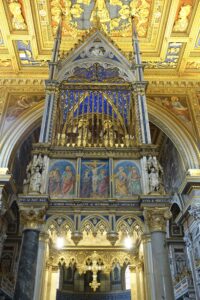
Today, the skulls of saints Peter and Paul are encased in gold statues above the altar in the Archbasilica of St. John Lateran. The Popes lived at the Lateran for centuries, and it is still the Cathedral of Rome.
It is fitting that the skulls of the two saints who helped establish the church would be honored in this location.
WHO: Pope St. John Paul II and Pope St. John XXIII
WHERE: St. Peter’s Basilica
When you hear the word “saint”, you might think of historical figures with halos and robes, not people who lived in the same era as Google and Facebook. But holiness isn’t exclusive to any one time.
Pope Saint John Paul II is not only a cherished saint, but one of the most prominent figures in the 20th century. Growing up in Poland, young Karol Wojtyla survived both Nazi and Soviet regimes. His holiness was so evident that he was made a bishop at the age of 38. In 1978, the college of Cardinals elected Karol as Pope. He is remembered for his strong stance against the USSR, his outreach to other religions, and his engagement with the youth. Pope Saint John Paul II stressed a universal call to holiness, telling the whole world that anyone could be the next saint.
Pope Saint John XIII has a special place in the hearts of the Italian people. Among Italians he is known as “good Pope John.” While this Pope is most fondly remembered for his good humor and joy, John XXIII played a critical role in leading the Church into the modern age. He was the first Pope to begin inter-religious exchanges and to appoint cardinals from Africa and the South Pacific. Calling for the Second Vatican Council is his most lasting legacy. While Pope John XXIII did not live to see council’s end, the reforms that came out of this meeting have shaped the church as we know it today.
You can find both of these saintly Popes under altars of St. Peter’s Basilica. You can see Pope Saint John XXIII’s body under glass, near the baldacchino. While not visible through glass, you can venerate Pope Saint John Paul II at his tomb under the altar of St. Sebastian, near the Pieta.
WHO: St. Bartholomew
WHERE: San Bartolomeo all’Isola
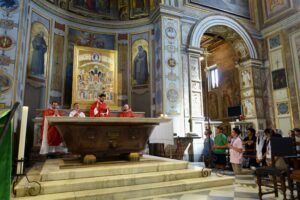
Did you know that six of the Apostles are buried in Rome? Bartholomew, also known as Nathanial, is buried under the high altar of the church that bears his name. It’s located on a tiny island in the Tiber.
In 2000, John Paul II dedicated this church to the memory of the martyrs of the modern era, and you’ll find relics of saints martyred under Communism, Nazism, and other persecutions of the 20th century..
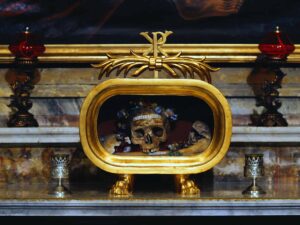
WHO: St. Valentine
WHERE: Basilica di Santa Maria in Cosmedin
Believe it or not, Valentine’s Day wasn’t created by Hallmark or the flower companies. February 14th is the feast day of St. Valentine, an early Christian priest and martyr.
Valentine ministered to the underground Christian community in Rome throughout the 200s. Remember, Christianity was illegal at the time, so all practice of the sacraments was putting one’s life at risk. Valentine continued to secretly marry many Christian couples. Eventually, the Romans arrested Valentine and sentenced him to death. During his imprisonment, he evangelized to the Roman judge overseeing his case. The magistrate brought his blind daughter to see the imprisoned priest, testing the power of Valentine’s faith. St. Valentine laid his hands on the blind girl and restored her sight.
When being taken to his execution, the saint left a note in his cell for the judge’s daughter reading, “Your Valentine.” This note sparked the tradition of sending cards on this holiday. The patron saint of lovers was beheaded on February 14th, Valentine’s Day.
You can find St. Valentine’s skull on the left side of the Basilica di Santa Maria in Cosmedin.
WHO: St. Helena
WHERE: Basilica di Santa Maria in Ara coeli
So far, we’ve seen apostles, popes, and bishops. Now we’re going to meet a mother, a legendary archeologist, and an Empress of the Roman Empire — St. Helena.
Born in Greece in the mid-200s, Helena grew up a poor stable maid. As a young woman she fell in love with a Roman commander, Constantius. They were married and had one son, Constantine. Constantius divorced Helena to marry into Roman royalty and further his political career. Her ex-husband eventually became emperor; however, her son never lost his devotion to Helena.
Upon Constantius’ death, Constantine ascended to the throne and named Helena Empress. Shortly after she took the throne, Helena converted to Christianity. She undoubtedly exposed her son to Christian morals and ideas, influencing his conversion. Constantine legalized Christianity in the Roman Empire in 313, ending the persecutions.
Helena used her position to lead an archeological expedition to the Holy Land in search of relics. While in Palestine, she built the Church of the Nativity, to preserve the spot where Jesus was born. Helena destroyed the Roman temple on top of Calvary and dug for the true cross. Her excavations revealed three identical wooden crosses. Unable to tell which was authentic, she laid a dying woman on top of each artifact. When the sickly woman touched the final cross, she was instantly healed.
Helena brought the true cross to Rome for safe keeping. But this wasn’t the only artifact she found on her journey. Helena uncovered nails from the crucifixion, the crown of thorns, the sign that Pilate posted on the Cross, fragments of the pillar that Jesus was chained to, and the stairs from the Praetorium that Jesus ascended to meet with Pilate.
You can find St. Helena’s remains in the Basilica di Santa Maria in Ara Coeli under a colorful statue of the Empress clutching the cross.
Curious about going on a pilgrimage to Rome? Discover more here.